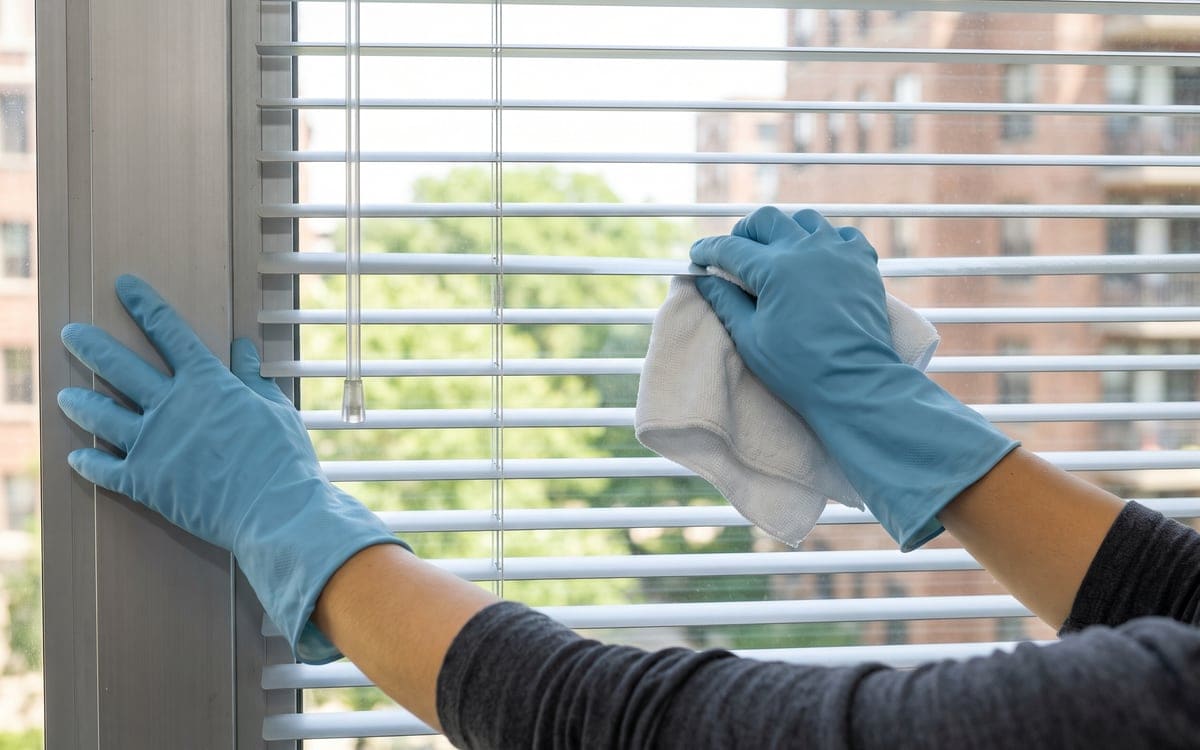
Every slat, louver and fabric cell is a small shelf for dust
A single blind can hold dozens of these small shelves, and the dust that lives on them is the dust that lifts back into the room.
When the heat kicks on, air moving through the register past the window lifts dust off the blinds and settles it across the rest of the room.
Venetian slats take a slat-by-slat wipe
Horizontal blinds, usually called Venetian whether they are metal, plastic or faux wood, come in two orientations: tilted open or closed. For a dust pass alone, closed is easier because the slats line up and a damp cloth sweeps across all of them in a single pass. For a thorough clean, the slats go tilted one way for the top-of-slat pass and the other way for the bottom-of-slat pass. Each slat gets its own wipe.
The cloth is a damp microfiber folded over the index and middle fingers, with the slat caught between the two folds. The pass goes from the string side of the blind out to the open side, so the dust falls off the open end into the vacuum nozzle below rather than onto the floor. The sill underneath gets a final wipe once the slats are done.
Cordless cellular shades take a dry duster and a careful vacuum
Honeycomb or cellular shades are the ones built out of folded fabric cells that stack when the shade raises. They are soft, delicate and not meant to meet water. A dry pass only. A soft duster goes across the cells with the shade pulled down flat, then a vacuum with a brush attachment and low suction clears what the duster lifted.
A damp cloth on cellular shade fabric leaves a water line that stays. A full-wet wash takes the shade off the window and belongs to a specialty cleaner, not a house cleaning visit. We do not take blinds down.
The water rule for real wood blinds
Real wood blinds, meaning blinds made of solid wood rather than faux-wood vinyl, do not want water. A dry microfiber or a dry duster across each slat is the pass. If a wood slat has a stubborn mark, the cloth is barely damp, enough to feel cool against the back of a hand, and the wiped slat gets a dry pass right behind.
Water on a wood blind soaks into the finish at the edges, lifts the sheen, and can warp the slat over time. The dry pass avoids the whole problem.
Plantation shutters open flat and get the top edge wiped
Plantation shutters are a cross between a Venetian blind and a built-in piece of trim. The louvers are wide and the frame is permanent. For a dust pass, each louver gets a wipe on both the top and the bottom, with the shutters tilted open for the top pass and closed for the bottom pass. The frame around the shutter gets its own damp cloth pass at the end, and the slim gap where the shutter meets the window frame gets a soft brush.
The louvers are deeper and the frame is wiped too, which is why a room with four plantation shutters is more work than four Venetian blinds.
Kitchen blinds carry a greasy film and need a damp pass with mild soap
The blinds in a kitchen, or any blind near a stove through a wall, pick up a thin film of cooking oil that holds dust in place. A dry pass alone does almost nothing in a kitchen. The damp cloth with a drop of mild dish soap takes the film off, worked slat by slat. The water in the bucket turns gray sooner than in any other room, so it gets changed more often.
A kitchen blind that has been running on dry passes for a while needs more than one wipe per slat to come clean the first time. After that, a damp pass as part of the household's rhythm keeps up with the film.
A regular visit dusts blinds; the slat-by-slat pass sits in a seasonal visit
The weekly pass on blinds, a duster across the fronts, fits in a weekly maid service visit. The slat-by-slat pass belongs to a spring clean after the heating season, which lists blinds wiped slat by slat. For a tenant doing a lease ending, the same pass fits in a move-out cleaning as part of the full-apartment pass.
What each blind takes on a visit
| Blind type | What a visit covers | What is a household step |
|---|---|---|
| Metal or plastic Venetian | Spring clean and move-out: damp cloth slat by slat | Dry duster between visits |
| Faux-wood Venetian | Spring clean and move-out: damp cloth slat by slat | Dry duster between visits |
| Real wood Venetian | Not listed on a service page | Dry microfiber or duster across each slat; barely damp only on a stubborn mark, dry pass right behind |
| Cellular (honeycomb) shade | Not listed on a service page | Soft duster across the cells, then a vacuum with a brush head on low suction |
| Roman shade | Not listed on a service page | Soft duster, then a vacuum head over the folds, dry only |
| Roller shade | Not listed on a service page | Dust the roll; a household damp wipe is the owner's choice |
| Plantation shutter | Not listed on a service page | Damp cloth on each louver and the frame, with a soft brush in the shutter-to-frame gap |
| Vertical blind (patio door) | Not listed on a service page | Dust each vane; vacuum the floor track |
Blind cleaning in Chicago heating season
Chicago runs a long heating season, and the dust that comes with it moves through the blinds. The city averages 121.3 days a year with a low of 32 degrees or colder.1 The normal first autumn freeze at O'Hare comes on October 19.2
In an older Chicago apartment, the blinds also carry the dust from a radiator in the room. Cleaning radiators and a blind pass fit well together: the radiator dust comes up first, then the blinds get wiped, then the floor around both gets vacuumed. Older Chicago apartments covers the pattern that comes with vintage housing.
What to have ready before the pass
What to have ready before we come covers this for every visit. On a day that includes blinds, pull the furniture under the window away from the window by a foot or so, so we can stand square to the blind and the vacuum nozzle fits under it. Point out any blind that is loose at the headrail or has a broken slat, which is a repair item for a blind pro, not a cleaner. If a blind is loose on the string or the tilt, we leave it alone during the pass.